Saturday, November 23, 2019

36 Square Miles of Generosity

Within a few weeks of moving to Big Stone County I was visiting a neighbor when another neighbor stopped by.  He was an elderly gentleman with a happy disposition and let my neighbor know he was there for the Combined Township Drive.

My neighbors chatted for a while and the gentleman left with one check for a variety of community charities- the library, firefighters, hospice, cancer society, disability services and more.  

Now you might be familiar with Township Combined Fund Drives, but I was not.  But it warms my heart to seeing neighbors encouraging and enabling neighbors to give back to the community.  How it works is that every year someone in the township pulls together the list of about 20 charities and contacts everyone in their township to contribute- in person or by mail.  People chose which charities and how much to contribute.  Then wrote one check to the Township Combined Fund.  The person collecting the funds then sends the various charities the money.  And let's the newspaper know how.much their township raised.

And people give - year in and year out.  There are less than 100 residents in our 36 square mile township.  And it's not just our township that has this practice, it happens in every rural township in our county.  Our newspaper then shares the results of each Township Combined Fund.

There are some spirits and traditions that are worth preserving and sharing.  I count this neighbor to neighbor encouragement to give one of those cultural practices we should applaud.

Thank you to everyone who labors with the combined funds in our townships.

Have you heard of this before?  I'm interested in hearing if Combined Fund Drives happens elsewhere.

Tuesday, August 27, 2019

China, Tariffs, Deglobalization - All Rolled up in Last Night’s Dinner

The news of the week included a trade war with China, tariffs, and a Tweeted presidential “order” for United States companies to get out of China.  Listening to the news, I’m standing in my kitchen with a bit of China in my hands – wild caught Alaskan Salmon, no less. 


Schwans Alaskan caught salmon

Our global economy is complex and driven by consumer goods.  You can find Stuff made in China everywhere you look and a person might buy enough to make their lives cluttered while taking a toll on the environment.  I’m curious what a tariff on China would do to the supply and cost of stuff that fills the shelves of dollar stores? Much of it is replaceable – in small towns through Minnesota you can find thrift shop storefronts filled with used items that could replace most everything you need from a dollar store or Walmart (and sometimes the used Stuff is more durable and higher quality than the new).  And little more use of things like real plates and less foam disposable plates would do the world a bit of good.   I’m grateful to take the 35 seconds to wash a few plates and eat off of a real plate than disposable – it feels respectful to the food and my family.  But I digress!!


Back to the salmon.  Between our farm and neighboring farms, I don’t buy meat from a store. We raise our own grassfed beef and free range chicken on our farm and I buy pork and lamb from neighboring farmers. Seafood is, obviously, one of the foods that we cannot grow or buy from neighbors out in the Tallgrass Prairie.  So I turn to my friendly Schwan’s person – a young woman of color – who comes to my farm every other week with her yellow truck.  That’s where I get my seafood – like the Salmon pictured above. 

What a trip that salmon has been on!!


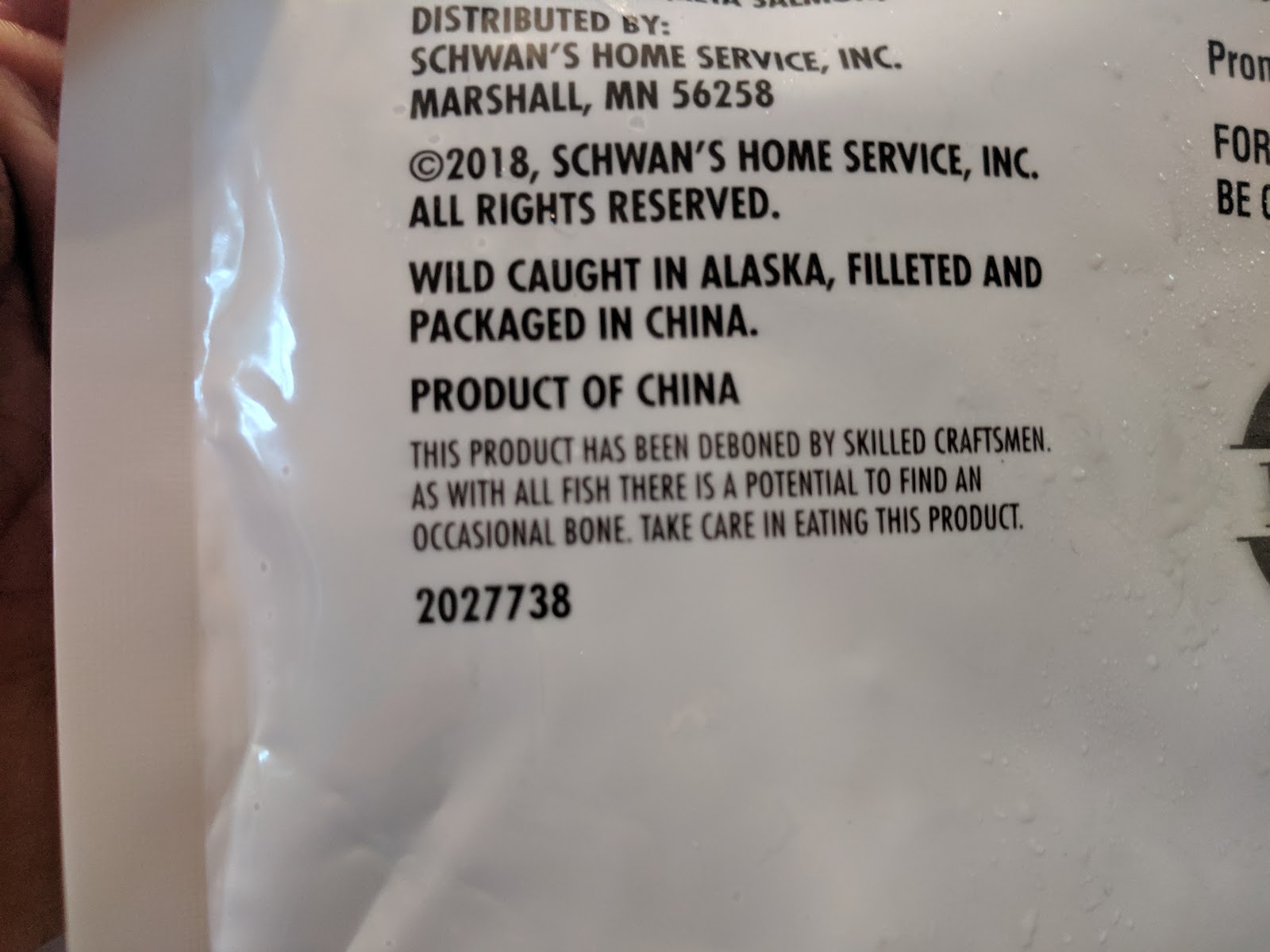
The label says “WILD CAUGHT IN ALASKA, FILLETED AND PACKAGED IN CHINA  PRODUCT OF CHINA

What is the impetus for having wild caught Alaskan salmon transported to China processed and then delivered to my farm in Big Stone County?  Why is it economically efficient for that salmon to travel that distance? What makes this supply chain profitable?


What makes this supply chain profitable?
  • Outsourced Pollution:  Cooling, flash freezing, and maintaining the salmon in a deep freeze takes a lot of electricity.  Fewer environmental regulations, like air quality, keeps the cost of Chinese power lower, thereby saving money on electricity for an energy intensive food product.  Cheap, dirty power is readily available in China.
  • Cheap labor: Please see the fine print on the label below. It says, “THIS PRODUCT HAS BEEN DEBONED BY SKILLED CRAFTSMEN.


Are there no “SKILLED CRAFTSMEN” in Alaska?  What is the difference between a skilled craftsman in China vs Alaska.  I’m guessing the difference is: 1) the cost of labor 2) worker protection and 3) the resulting availability of labor.  If the wages and worker protection for salmon deboning “skilled craftsmen” had living wages in the US, I maintain that people would take those jobs.

It is our US need for cheap food that forces skilled jobs, like salmon deboning, to place where the workers have little choice or protection, i.e. China.  This is called global wage arbitrage – a situation whereby globalization has allowed corporations the world over to search out the absolute lowest wages and meanest working conditions on earth, for their and their shareowners profits.  My guess is that there is a fair amount of worker misery in every bite of my salmon.

So I find myself in the awkward position, as a farmer with many fellow farmers suffering from the tariffs, to wonder if the tariffs may have some benefit to workers in the United States.  Maybe Alaskans will get safe and well paying, skilled labor jobs deboning the salmon that is caught in their waters.  Maybe the environment will be a bit cleaner without the cheap, dirty power used to freeze the salmon and eliminated a global circumnavigation of the fish on my dinner plate last night.
So hang onto your hats folks.  What happens in de-globalization?  Your food will be more expensive, but maybe the global environment (think CO2) will improve and maybe US worker wages will improve, since they have been stagnant for 40 years.

Ok – Now I need to reconsider eating China imported salmon.

Monday, August 5, 2019

Still Here

Until a few weeks ago this road was under water for the better part of a month. It was a long winter and a wet spring.  Doesn't make for good farming or gardening.  


But summer has arrived and fresh loads of gravel to restore the road after weeks under water. And fresh clayey gravel makes a nice palette for some words of inspiration.  


It's going on 12 years since we moved our family from St. Paul to the farm in Big Stone County.  I read somewhere that the average back to the land folks lasted about 7 years and then moved on.  We've passed that milestone.

Lots of experiences, lessons learned, hopes, dreams, disappointments, and a few heartbreaks here and there.  But we're still here.  And I'm setting an intent to share more stores from rural Big Stone County and my View from Here.


Sunday, February 26, 2017

Just say NO!

"Let them eat cake" said Marie Antoinette when told that the peasant had no bread.  And now there is a bipartisan effort to have Sunday sale in Minnesota.  And who does it benefit?  The small town liquor stores - NO.  This law would spread the same amount of sales over more day, increasing their operating costs.  Does it help service workers? NO - service workers now have to add a Sunday shift and take time away from families.

And for what?  So that people who don't have to work on Sundays and who forgot to buy their champagne for the Sunday brunch Mimosas can shop conveniently.  And let the service workers eat cake while you enjoy your Sunday with guests properly libated.

Just say NO.  The DFL used to care about working people.  Now both Republicans and Democrats want service workers to work on Sundays so that they can be served on Sunday.  Do you remember how great an achievement it was to have a 5 day work week?  Of course not, that was 1908.  And for most of us, the salary class, the five day work weeks still exists (kinda sorta if you can turn off the phone).  Those of us in the salary class don't have to be on our feet all day on a Sunday selling alcohol for the convenience of people who don't have to work on Sunday.

Hey! DFL Senators.  Do a rural DFLer a favor and VOTE NO to Sunday Sales.  Show rural service sector workers that the DFL still cares about them. The Sunday Sales lobbyists say we should be like our surrounding neighbors and forget about small town businesses and service workers having a day off.  But what is one thing all those neighboring states have in common?  They've all turned red.  Do you think that our disregard of rural working class Americans had anything to do with that?  Maybe the reason Minnesota clung to some remaining "blue" in the sea of "red" was because we still had some vestiges of Labor left in DFL.

And rural Republicans VOTE no for all the reasons of keeping small town businesses competitive and viable and remembering the Sabbath. Keeping the Sabbath is Common Sense, no matter what the lobbyists say.

Come on people.  Do you really need to make others work so that you can buy alcohol on Sunday.?  Really.  Seriously - just give it a rest already.  It's only helping big box stores, large corporations.  Stand up for the little guys.  Just say NO to Sunday Sales.

Sunday, February 23, 2014

The Real Happiest Place on Earth

Gallup poll results came out this week ranking the Happiest States in America. And despite the endless days of subzero weather and blizzards Minnesota ranked among the top Happiest States in America.

Big Stone County, the bump on the western edge of the MN, is kinda in the middle of the cluster of Happiest States in America- in green. Why do you think that is? Wide open spaces, 4-H, bowling leagues, highest per capita farmers, a "could be worse!" culture? Maybe it's our pleasant winters.
One small thing that makes me happy living in Clinton, MN is that my grocery bags are colored by the elementary kids- most of who I know. With messages about reduce, reuse and recycle. And the kids (Kindergarten through 6th grade) put a lot of effort into these bags, which turn out both beautiful and artsy!

I just love the children's art put into useful everyday items and then spread throughout the community-- again and again. And these bags can be and are used over again because they are too special to toss and you feel like you need to handle this child's art with care. I'm bringing all these bags back to the store for the next lucky customers. And frankly, that's something you might not be able to do in a large city. The grocery store might not take bags from some random person wanting them to be restacked at the checkout line and reused.
There was one bag I liked in particular--a watercolor with fall leaves and a message "Don't Litter. It Makes the world bitter." Imagine my delight when I found out that it was painted by one of my own sons. And it's no coincidence that I got that bag--Bonnie and Holly at the grocery store tucked that one away to make sure that my groceries would end up in it.
Let me tell you a little story about a Kindergartener whose name was on the bottom of one of the grocery bags. I make it a point to meet the bus every afternoon when it pulls up to the end of my ½ mile long driveway. One afternoon the bus pulled up and off jumped my two little boys and one of their friends, for a planned Friday sleepover. And then off of the bus comes the sweetest, cutest little 5 year old girl. I looked at the bus driver quizzically and he said she was to get off at our house.
Now, it was a completely blameless situation. The little boy was her brother and they had gotten on and off the bus at our house before. So when the bus driver saw the note giving the brother permission to get off at our farm, it made sense when the little girl, we'll call her Izzi, said she was to stick with her brother. And Izzi herself was quite convincing to the bus driver that she was to go to our farm with her brother.

But what an unexpected treat for me! My own Alma and I got to walk down the driveway with little Izzi - "1, 2, 3! SWINGing" Izzi up into the sunny sky. And once at home it was "Raise High the Roof Beams! Break out the Candy Land and Dust off the Barbies!" Can you imagine such luck and fun on a Friday afternoon out on the wide open prairie? Now Izzi's home is the absolute other side of the 40+ mile wide school district, so we had a nice block of time to play before someone came to pick her up.

So I invite you to try living in a world where the little things, the bag you get your groceries in, can bring such simple pleasure and invoke such sweet memories. A place where a child's hand crafted artful bag can make its way into your home and your life--occasionally accompanied by the child themselves (both on purpose and on 'accident'). To experience the delight of reading the names of each precious child on the bottom of your bag can bring smiles and a cry of delight.
And remember these messages from the children of Clinton-Graceville-Beardsley Elementary
• Recycle or your ecosystem will fall apart (reduce, reuse, recycle. Save me for Christmas)
• Recycle- Batman does
• When you toss out paper, you're killing trees. DO NOT toss out paper.... RECYCLE
• Go Green, Recycle, Recycle, Recycle
Maybe the Happiest Place on Earth isn't a place, or if it is a place, it might be a place that is small enough to care about. But wherever it is, it is about noticing and appreciating the small things.

Sunday, February 16, 2014

Rising from the Praire- Abbey of the Hills

Stained glass window in the small chapel
Last weekend the kids and I went to the open house at the former Blue Cloud Abbey, now Abbey of the Hills, near Marvin South Dakota. This place is a gem upon the prairie. It somehow captures so much about this place and its prairie beauty and foreshadows some of the past century of this place.
Abbey of the Hills rises up out of the Prairie Coteau. You can see the Prairie Coteau rising up out of the prairie from where we live, on a crisp clear day. The first time I drove west from our farm, with my mom and kids to buy vegetable from the Hutterite Colony, my mom said "what's that rising up out of the prairie." "Must be a bank of clouds," I said, because I hadn't heard of any hills or mountains on the other side of Big Stone County, MN. But I was wrong. The Prairie Coteau is hauntingly lovely "Alps of prairie" as described by the early 1800's explorer Joseph Nicollet.
It is in these hills that a group of Benedictine monks built their Blue Cloud Abbey in 1950. This place is just 40-some miles from our farm. A refuge.

I'm not Catholic and so won't claim to know the heart and spirit that went into these monks, whose stained glass window says "Pray, Read, Work", finding and building this place. There's a good story (click here) about how they found this piece of land on their way from one place to the next.

And they built this place both simple and glorious. An Abbey in the Prairie Coteau- a place of subtle and astounding beauty in which to seek G-d under blue skies. They built it, really, at the peak of its population and maybe hopefulness. Or before we even knew we needed to be hopeful. Because family farming was still thriving all around them out on the prairie and there were still young men and women inspired to live lives of "Pray, Read, and Work."
But things have changed since 1950, haven't they? The independent farms that dotted every section of land have been consolidated and the homesteads are coming down. The number of young people going into full time religious life has plummeted. And both of those demographics meet out here on the prairie.

And so it was exciting news that after more than a year and a half of looking for people to buy the Abbey, that a group of 6 local families decided to buy it. It was bitter sweet news to learn that our inspiring grape growing and biodynamic farming neighbors were among the visionaries stepping up for this great adventure. They have relocated there are applying their skills and innovation to this place.
Here's the kayak that Dan built as a fundraiser for the Abbey. Now imagine that kind of craftsmanship and heart going into a place.


What's remarkable to me is that Abbey of the Hills is being remastered, in part, on a hope for this place that is a palpable hope for so many rural and family farm advocates--that we can find a way to thrive out in the country. What is that way? Well, for one thing, that is by having a healthy and local food system that nourishes our bodies, souls, and communities. Because when we lost those family farms, we lost the small town creameries, butcher shops, as well as the kids who attended schools, and the Masons who built sturdy and lovely brick buildings on Main Street. So those folks at Abbey of the Hills are looking at their sustainable farming operations, their greenhouse, their wood shop, art lofts. They are baking bread in their commercial kitchen and selling it in local grocery stores. They are hoping for a rural renaissance that includes a people landscape with good food and satisfied souls.

I found this butterfly on one corner of a wall of stained glass. It spoke to me of that transformation that I hope for our rural places and prayers for the success of Abbey of the Hills. The chapel was completely full of well-wishers for last Sunday's prayers and hymn.


On the way out, I had to wait for my kids. They'd met up with their friends and were having a great time catching up and exploring. I was standing in the concrete hall, the working part of the Abbey, between the greenhouse and the mechanic shop. I lingered there wondering where the heck my kids were. And then I looked up at the ceiling with the exposed pipes. And what did I see?

Even this 'industrial' corridor of the Abbey was touched by the spirit, where some Brother had discreetly put Leonardo da Vinci's Creation of Adam and the hand of G-d reaching towards humanity in between the electrical conduit. 


Saturday, September 28, 2013

Big Stone County Agri-Tourism

On Saturday, September 28th, a group of 30 people from Fargo-Moorhead area toured some of the small farms and local foods highlights of northern Big Stone County, thanks in part to a mini-grant from Minnesota's Sustainable Agriculture Research and Education program of the USDA. I think that this might be a first for our county. Even some local folks were surprised that the roads go both ways from Fargo and that a busload of people would spend an entire day checking out our small farms and local foods. It was a great day- organized by the tireless farmer Noreen Thomas from Doubting Thomas Farms in the Moorhead area.
The tour began at the Russ and Theresa Swenson farm just east of the Big Stone County line. The Swenson's grow garlic on a market scale as well as raising both milk and meat goats. They make a variety of goat cheeses on their farm including mozzarella, garlic and chive flavored hard cheeses, and soft ricotta type cheese. In Minnesota you can produce and sell cheese from your farm, but the only way to purchase it is to take a trip to the Swenson's farm. From our experience, it is worth the drive!
From there the tour went to The Cabin Café where Doreen Winston provide a lunch of homemade barbeque pork sandwiches and salads made from local produce- cabbage for coleslaw, fruit, local tomatoes, zucchini, and peppers. The lunch was served as a picnic at The Apple Ranch on Big Stone Lake, where the group had the opportunity to tour the orchard and buy locally grown apples, namely the Honeycrisps and Haralsons that are currently ripe.
From there the tour went to the Dan and Michelle Moberg vineyard, named Juanita's Vineyard after Dan's mother the late Nita Moberg. The delicious and cold-hardy Marquette grapes (from the University of Minnesota) are at perfect ripeness and the group had the opportunity to spend time walking in the vineyard and harvesting grapes to eat on the spot and to take back home with them. In addition, the Mobergs had samples of the wines they have made as well as grape jellies.
The final stop was the Mike Jorgenson family farm. The Jorgenson's have put a portion of their farm into pasture and are raising grass-fed beef, both Irish Dexters and Lowline Angus. They also have a University of Minnesota organic edible bean variety trial on their farm that includes both market classes like kidney and pinto beans, and specialty beans like cranberry and eagle's eye. Two U of M graduate students were there to both explain the field experiment and to begin harvesting some of the plots. The trial is to help select heirloom bean varieties that grow well in Minnesota conditions.
One aside from this trip, noted by this author, is the role of the University of Minnesota in the crops on these farms. Bette Johnson, owner of the apple ranch, made a point of telling the crowd that all of the nine varieties of apples in her orchard were developed by the University of Minnesota (though she did note that the more recent varieties that the U has released are not as accessible as past varieties). Likewise, the Moberg's noted in describing their vineyard operation that the three grape varieties they grow were develop at the U of M. The Jogenson's demonstrated first hand how the U of M continues to work with farmers to develop new crop and hopefully new markets.


Overall, the day was a success and many in the group hope to return. Already some have asked the Moberg's to invite them to help harvest grapes next year. They found the vineyard peaceful and the work "therapeutic" and would like to volunteer. Upon leaving, the group asked if there were places in Big Stone County where they could hold retreats and stay for more than a day. With places like the Beardsley Lodge open, it is hoped that more tourists will discover the hidden and not hidden treasures of Big Stone County. It is gratifying to see outsiders appreciate the beauty and the local foods that our area has to offer.

Monday, August 26, 2013

Berry Rich: On Neighbors, Family, Soil Conservation, and a good Sunday Dinner

Photo courtesy of the Kansas Historical Society, 1899

It's already the end of August. Summer passed by too fast ~~ a few wafts of regret. I didn't make enough time for swimming and gardening and family. Today, however, was a beautiful day despite life threatening heat indexes and the increasingly severe drought conditions. It looks like this lovely day that will end with our family of five sleeping in the living and dining rooms--the only rooms with air conditioning. That's fine. We've lived here six years next month and this is the first time the heat has driven us out of the upstairs.

Mike noticed the cattle getting heat stressed in our western paddock. The grass is high and deep, but there is no shade out on the open prairie. One of our low-line Angus had gotten herself into the water tank and the other Angus cattle were panting (Note: Mike has observed that our Dexter cattle seem to handle the extreme weather better than the Angus).

So the two of us left Sunday dinner and herded the cattle back around the farm and into the paddock by the barn that has a watering pond surrounded by trees that Mike and his dad dug out years ago. Today I didn't have the camera with me and missed capturing the most strikingly beautiful scenes. As I closed the last gate behind Mike and the herd, I saw a view that I want imprinted in my mind for the rest of my days: Mike walking in his Australian sun hat, white t-shirt, blue jeans leading his herd of cattle across a bright green, neat and clean pasture. The sky was blue, a few white clouds. 30 brown and black cows followed trustingly despite the painful heat. When we got through the last paddock the cows took off at a run!! They raced through the green grass (it will be brown soon without rain- which is not in the long term forecast). They ran to the shady pond and every last one of them waded into the water--some went in over their backs-- their noses touching and drinking the water-their panting subsiding as they cooled off in the water. Happy cows.

We stood and watched them for a while; basking in their relief. We make plans to deepen that pond in the fall, just in case this drought continues. Then we returned to our Sunday dinner with Mike's mom, dad, uncles, and an aunt. An all around good day.

Let me tell you about this Sunday dinner, brought to us by the farms and farmers of Big Stone County. We had a grilled leg of lamb (thanks to Radamachers), cucumber salad (Shumachers), greens, spuds, and an Aronia (choke berry) pie.


There are a few different stories around that Chokeberry pie- stories about community, family, health, and soil conservation. The journey to getting this pie on the table started at the café where I stopped to get a cup of coffee on Friday morning. There were a group of beautiful, elegant, and kind local matriarchs enjoying a coffee gathering. As a result, I was invited to pick berries at Marge's farm. Izzy was at the café and also interested in some berries. So Saturday morning my kids, Izzy and I drove to Marge's- a nice multi-generational farm with a variety of animals and crops including the first mature, full fruit bearing Aronia bushes I have had the delight to encounter.

Aronia, also known as choke berry (not choke cherry, which people are more familiar with), is native to our region and produces seedless berries, larger than blueberries. Aronia is touted as the next "superfruit" because it is full of healthy nutrients and is attributed with all kinds of health benefits.

Whooo hoo!!! I was just giddy to have a chance at these berries. Izzy, Marge, the kids and I picked berries for about ½ hour and harvested about 8 gallons of berries. The berries are in clusters, about eye level, come off without stems attached. Easy, easy, easy!
At home we processed them into pie filling, jelly, syrup, and juice. A number of fun hours and a huge mess- as these projects usually are. When each batch was finished the kids descended upon the kitchen to lick the pans and spoons.

How did this great stand of Aronia berries come about? Well, they were planted with the advice and assistance of a United States Department of Agriculture, Natural Resources Conservation Service program called EQIP (Environmental Quality Incentives Program). This program provides cost share to plant wind breaks and implement on the ground conservation practices, like grassed waterways, pastures, cover crops and even organic farming. The NRCS and their close colleagues the Soil and Water Conservation Districts (in every Minnesota county) are really where the rubber hits the road in getting conservation practices onto the landscape. These are the guys with the equipment (like tree planters and native seed drill presses, the plant material (thousands of trees, grass mixes, etc...) and manpower to lay down the landscape fabric, plant the trees and the prairie grasses.
Now, here's the deal. You can buy any tree imaginable from the SWCD for the EQIP program- the point is to hold the soil in place. The "ah-ha!" is that we can select trees and bushes that also provide human and wildlife food. There are a whole lot of folks interested in growing and others interested buying locally grown food. And here's a chance to do double and triple duty on the land- soil conservation AND food and food ventures. On our farm, with the help of NRCS and the SWCD, we've planted our windbreaks with 400 fruit and nut trees including:
Aronia (chokeberry)
Prairie Red Plum
Chokecherry
Hazelnuts
Mulberry
Black Walnut
Hackberry
Chestnuts
Gooseberries
It's a cool idea to have an edible windbreak as a conservation practice, but there's still work to be done to catalog and promote these multipurpose tree plantings to include fruits and nuts. There are all kinds of reasons this is a good idea including increasing access to healthy foods in rural places, like Big Stone County, which is a USDA designated "Rural Food Desert." So it's win-win-win: keep your soil in place, grow some pie and jam berries, and if the harvest is good enough you can even sell those berries. What is needed is to get the information together on the how's and why's of growing these trees as part of the EQIP program and then get the word out that you can plant your windbreak with fruits and nuts.

By the way, the pie was an absolute hit across three generation. With a good cup of coffee, some more stories about barn building and how the electricity came to these parts in 1941, I'd say it is just about the most satisfying piece of pie I've ever enjoyed.

What stories did you take part of or hear lately? Do you have or remember ground cherries and gooseberries?

Friday, July 5, 2013

A few good hours of farming

There were about 24 giddy hours where we felt like we had finally done something right on the organic portion of our farm (about 40 of the 320 acres). We've had a few trials and errors compounded by both floods and droughts. Seems like if we are committed to any particular thing, it is a commitment to experimenting. Problem is we got skunked a few times with our experiments. The tillage radish was good, but no income. We gave organic corn a shot, but ended up plowing it under. So this year, lo and behold, we got our first crop off the 40 acres.


Alfalfa bales

It's an absolutely gorgeous crop of lush, green, alfalfa. One heck-uv-a yield. I kinda get that whole "waiting to exhale" idea. We've been holding our breathe on so many of our farm ventures and finally one of them turned out well. Sigh.......
The other precious thing about this hay crop is that part of it was harvested with a lot of family and neighbor hands at work. The kids and I drove in from an evening of roller skating to find a couple haying efforts underway-- though it was growing dark. The kids ran down and pitched in with Mike, Russ, Theresa, and kids. Pumping out small square bales and putting them on a hayrack. Just a couple hundred that way, but still-- a perfectly wholesome farm and family night.
Last night, we jumped in the car and went to the street dance in Clinton, MN. When asked how the farming was going, we beamed. "Great!" "Excellent!" "The alfalfa crop was great and it's baled!"

We had a solid 24 hours of farming we could brag about.
And then the phone rang over breakfast-- cattle out of their paddock on the US Fish and Wildlife land. Mike has spent the last few weeks toiling to fix 50 year old fences so that we could graze our cattle on the adjoining federal land (we've worked out a lease with the US Govt).

As it turns out, our cows can swim. Even the little babies it appears. They swam around the fences that went up to the edge of the slough. So we geared up with waders, fence post, wire and headed out to separate our cattle from another herd they had decided to 'mingle' with and set up fence into the slough.

Getting fence post set so the cattle will stay put

It was 94 degrees, hot and buggy. But we got the job done- new fence up, cattle herded back. That's a good feeling.

All in all, it is a joy to see this farm in grass. The cattle barely visible in a sea of shoulder high, tall grass prairie grass. And it looks like we now have enough hay to get this herd and a few more through the winter. Plus, we're going to butcher our first two steers- Trouble and Bill (yes, they have names). So stay tuned to order some grassfed beef from us. We're going to try it before we start to sell any.


I'll be back in the coming days with more cattle tales. In the meantime there are community celebrations to attend and fireworks tonight in Clinton, Minnesota. I am grateful for these days and this place. And I'll savor those hours when the farming is good, the grass is green, and we are living in the lushness and abundance of life on the tallgrass prairie.


Monday, May 27, 2013

Not Lost, but Gone Before (ikke tabt, men gaaet forud) -- Memorial Day 2013

Today my family paused to remember those who came before us and those who served. Maybe you did too. If so, please add a comment and share where and how you remembered.
 Parade starts in front of the Clinton Memorial Building at 9:15am


Being part of a small town requires us to be a part of the activities- Alma in the band and the boys riding bike in the parade (the latter was voluntary). Also being part of an immigrant farming community brought us to our ancestor's church- open one day per year--to remember.
Parade ends at the elementary school. This woman stands and watches the parade each year- each year it moves me
It's a healthy exercise to be grateful for others' sacrifices and to remember our own mortality as we spend time in ceremony and cemeteries on this Memorial Day. That's what took place today in Big Stone County, Minnesota and many other places.
I liked the patriotic seed cap
It's a somber day and feeling. Not lightened by the cool, gray weather, the decaying buildings, the people remembered in death this year who were with us in life last year.

Heads bowed as the name of each deceased service man and woman from our community is read aloud and followed by a drum roll.
2nd Lt. Jacob Lillehaug talked to us about remembering the people- the individuals who serve and served their country. A good boy from our small town, invited home. Asked to be wise as age 22, maybe 23. And we are grateful, grateful for him going out into the world- with our blessings and on our behalf. And remembering those from the Baatan Death March- for touching them, few that remain, as they touch him. Godspeed Lt. Lillehaug.

A deserted and lovely Main Street- as we leave early for the next service we will attend
From Clinton, we head to rural Long Lake Church. This is the church of my mother-in-law's family. A church of immigrants- largely Norwegian and Danish

Long Lake Lutheran Church- established 1872 and built in 1890
They hold one church service and potluck dinner here each year- on Memorial Day. My mother-in-law plays the pump pedal organ that still sounds lovely after all these years and dozens upon dozen unheated winters.

We sing from the 1913 copyright, 1927 published Lutheran Hynmary.


Enjoy a real Lutheran potluck dinner- complete with an amazing rhubarb custard pie and an exquisite tatertot hotdish.

Lutheran church potluck dinner
And then we walk through the cemetery and remember the family members buried there. For us, it is Mike's grandpa and grandma. The Brustuens.


On the last Brustuen grave we visited were the words "Ikke tabt, men gaaet forud." None of us knew what that meant. Thanks to Google translator we know it means
"Not Lost, but Gone Before."

Some things are lost. Those first generation immigrants tongue and their language is, in fact, lost to us. Their legacy continues on. It is a good, wholesome, respectful legacy of family, community and farming. It comes from and leads to honorable service. Humbling and honorable service. I suspect my husband left with the hope and maybe a promise to come back and help fix the shingles on the roof of that old church.

Thanks you to those who brought us to this place and for those, known and unknown, who have defended our freedoms these many years so that rural Minnesota can be a peaceful place.

Saturday, April 20, 2013

Minnesota Traveler

Have you had enough of this long winter? It starts to wear on a person. Minnesotans have winter travel weather tales. And this has been a good winter to accumulate more- it's been a long, some might say brutish, winter. My work involves a lot of travel and I try to arrange it between winter storms. That didn't quite work out this week. But, obviously, I made it home alive and so all is well.


It hadn't been a good day at work in St. Paul; I was vexed, largely because of my own doings, and just wanted to be home. I had calculated that I'd have about 78 hours at home before I needed to leave for another 5 day trip. So I pointed my car west and headed heedlessly into the storm in the midafternoon. The schools had all closed like dominos ahead of me and many places of work, including some offices of my own organization in greater MN, had shut down and sent people home early.
Thanks to Alma, my road crew, who kept updating me on the MNDOT 511 road conditions the entire time (via hands free car phone, mom). All of which were "hazardous" and "no travel advised", with the occasional "difficult" to look forward to.

And it was an exciting trip those first 150 miles. When I stopped in Glenwood to pry my white knuckles off the steering wheel (now 5+ hours into what normally is 2.5 hours of travel), a guy at the gas station looked at my frozen and ice packed car and said "wow- what have you been driving through?" "HA!" I said- "hope you aren't heading east! It's brutal." There were cars all over in the ditches- on the MNDOT road condition map (above) all those purple diamonds are spin outs. In just the five miles before Morris, there were 3 cars newly in the ditch. How did I know they were "newly"? By the surprised and still faces of people still sitting behind their steering wheels.

Found my car iced over when I pulled into Glenwood

But the real excitement- the kind that makes you forgot all of your troubles- started when I turned south onto the Chokio road. I heard this "crrrrrrrrrr" sound under my car and realized that the snow on the road was up to my bumper and my chassis was pushing it down as I drove through it. If I slowed down now I would be stranded- 16 miles from home.
Note: This whole trip had a sound track and it was loud and thumping. I don't know about you, but Public Radio was not what kept me sharp and confident to keep my foot to the pedal. It was a Phillip Phillips HOME kinda trip, with some Mumford and Sons for emphasis.
View on the main road- between Sauk and Glenwood

Maybe it's kinda, you know, sick to enjoy this. But I did. Those last 16 miles were pure white out blizzard driving through snow that was up to and above my bumper. As I crashed through, the snow came up my hood and over the windshield so that I couldn't even see. I had to open my window and put my head out. It's almost sensual with the mist of the blowing snow pelting my skin, melting on my face and my hands on the steering wheel. Every sense is alert- with time slowing down intensely. There are no curves on this road, I couldn't see the edges of it on the prairie and in the white out- so I pointed straight and kept my foot firmly on the gas pedal. If I had met a single other car those last 16 miles and had had to slow down, I would have been stuck in that snow overnight. There was still just barely enough light that I could see apart from my headlights.

And then -- a flashback to an earlier trip Mike and I had taken in with his brother and sister, home from Arizona. Same deal- we drove from the Cities in a blizzard, turned south on the Chokio road, but it was night. We pointed the car south and gunned it. But this time we veered ever so slightly to the west and got sucked into the 10 foot deep snow of the ditch. Buried. After some time another car came along, luckily, and we waved them down. They stopped and took the five of us into Chokio where we were put up for the night by a big hearted older couple. And this is the part of the story that makes me laugh every time. Mike and I were put up in the 'doll' room, which displayed the many dolls made and collected by the woman of the house. Mike's brother, being the single guy, got put in the Cuckoo Clock room. So all night long, every 30 and 60 minutes, more than 100 Cuckoo Clocks went off. See, I'm laughing again. We got the car pulled out of the ditch and made it to the farm the next day.

Back to this most recent adventure. I had to turn west off the Chokio road now - keeping enough speed to bust through the snow, but not so much as to slide through the turn and into the ditch. It was close and like spinning a wheeley on purpose. It was 100% white out as I climbed the glacial moraine past where I knew the township hall would be sitting, could I have seen it. By the way, during this entire last 16 miles I'm driving in the middle of the road as there are no lanes, no line, and barely any distinguishable road out on the flatland prairie.
Note: this picture was taken close to home, AFTER I was through the worst of the driving

And the tale might have just ended like this. "Kathy made it home safe into the arms of her loving family." And, in fact, that is precisely what happened. But there's something else. Honest to G_d- as I closed in on home, a pair of swans flew up from the side of the road- nearly hovering as they were trying to take off into the 30+mph wind. Two white swans hovering just in front of my car. And as I drove over the slight hill, I broke through the actual edge of this blizzard and into a pink sunset on the horizon. Have you have ever felt that G-d or the universe is sending you a message? It was the Welcome Home for my soul. I had been wiped clean of any cares while I just focused every cell on surviving and then BOOF! You break through into beauty, peace, nature.
The trip wasn't done- I still had the final four (miles). And I'm happy to report that I burst through the last drifts on our ½ mile long driveway and made it to within 10 feet of the garage when I hit the final drift hard enough to basically, as Mike told me the next morning, lift the car off of the ground and set it on top of the drift so that the wheels didn't touch the ground.
And (back to the happy ending) then she made it home into the loving arms of her family. The table set with a glass of Dandelion wine; roast chicken and potatoes held warm in the oven.
Note: I actually have three children, but only one which throws himself in front of every camera. So while there are a disproportional number of pictures, there is proportional amount of love for all.

I made that dandelion wine with one purpose- to drink it after a couple snow days when I needed to remember and hope for lush, green, flowering spring. Back in 2011, Jens and I sat outside one spring day picking the abundant crop of dandelions growing in our 'organic' yard. Buckets of bright yellow flowers, my boy in the green grass, sunshine, and blue sky over endless prairie. I have now finished off the last bottle and I'm ready. For spring.

Mike pulling my car out yesterday morning

I hope this note finds you well and hopeful for spring. What are your winter stories?